You may call your religion beautiful and moderate, but if it reduces some people to second-class citizens by refusing them full marriage equality, then your religion is a problem for society, causing many people to feel rejected and hated.
I know there are problems with extreme beliefs leading to terrorism and violence, but there is also a very widespread problem with supposedly moderate religions institutionalising prejudice. I used to think that this was not a serious problem until I watched a performance of a play about 'Proposition 8', in which a mother said "no girl dreams of being a civil partner".
That's true - why should the dreams of children who want to think of themselves as being fully accepted and respected members of family and society be crushed? Why should a child be told that he or she is second-rate, that their love isn't as real, isn't equal? That institutionalised lack of equality can and does lead to bullying of children, and worse.
A moral religion should not collude with such rejection, should not enable such hatred. It should teach that all are equal, that loving a member of your own sex is as wonderful and as true as the love between a man and a woman. Even this atheist accept that that would be a beautiful thing for a religion to do.
Wednesday, 17 June 2015

Friday, 12 June 2015
Belief in god - the Q Challenge
In the Star Trek universe there is a society of beings with almost omnipotent powers, called the Q Continuum. Each of these beings (all confusingly called 'Q') can perform what appears to be miracles. They play with time and space at the click of their fingers. There is nothing supernatural about the Q - in spite of their seemingly limitless powers, they are not gods. They are certainly not worshipped or considered sources of moral absolutes, even though they occasionally be rather friendly (although they can be deeply irritating).
The Q are conceivably true. There are no known principles of physics that could rule them out. And because of this, I consider that believers face the 'Q Challenge':
Come up with a single example of an observable act of a god that cannot be an act of Q.
The thing is, if there is no experience that can't differentiate between a god and a Q, then parsimony insists that the explanation be a Q. A non-supernatural Q, a flawed, capricious being utterly undeserving of worship.
The Q are conceivably true. There are no known principles of physics that could rule them out. And because of this, I consider that believers face the 'Q Challenge':
Come up with a single example of an observable act of a god that cannot be an act of Q.
The thing is, if there is no experience that can't differentiate between a god and a Q, then parsimony insists that the explanation be a Q. A non-supernatural Q, a flawed, capricious being utterly undeserving of worship.
Wednesday, 10 June 2015
Emptier than space
Space isn't empty. The view of quantum mechanics is that space is filled with things called 'fields' - basically the potential for particles to exist. The phrases 'electromagnetic field' and 'gravitational field' are widely used.
Electromagnetic fields can be easily messed about with by us - they are the basis of all electric motors, for example, and you can feel the forces of attraction and repulsion by playing with fridge magnets. The gravitational field is very much weaker, and we can't easily control it, for several reasons - the first is that the gravitational force per particle of matter or unit of energy is extremely small and so the force is only significant from large amounts of matter. We can't build a hand-held source of gravitation in the same was as we can build a hand-held source of electromagnetism (a torch). The second reason is that gravity is almost always positive - there is no convenient anti-gravity source we can use to cancel it out.
So, we have some experience of fields, but there are many more fields that we can't easily interact with without vast and expensive machines like particle colliders. There are at least fields for each kind of particle. There are electron fields for example. When particles collide in colliders they shake at these fields and, depending on the energy of the collision, they may be able to produce a wave in the field, and that wave is a particle. Shaking up the fields that fill the vacuum is the way that particles can be made, but it's not the only way. Quantum mechanics is based on the observation that there is always uncertainty (although very precisely defined amounts). There is uncertainty in the rippling of the quantum fields. That uncertainty allows for waves (particles) to spontaneously appear and disappear. These temporary waves are called 'virtual particles'.
Considering just waves in the electromagnetic field, these virtual particles - in this case particles of light - will appear at a range of wavelengths, from gamma rays to radio waves. Empty space is filled with these fluctuations in quantum fields.
However, we know how to block ripples in the electromagnetic field - metal cannot be penetrated by either radio waves or light. So, if you were in space and you had a metal box with you, such as a cake tin, and you closed the lid, what would be in the box? There would be all the ripples and fluctuations of the quantum fields in the vacuum - except for the ones that could not fit! There is no way that a radio wave of metres in length could fit into a cake tin! So, that cake tin would be in a strange state - it would be emptier than space!
Electromagnetic fields can be easily messed about with by us - they are the basis of all electric motors, for example, and you can feel the forces of attraction and repulsion by playing with fridge magnets. The gravitational field is very much weaker, and we can't easily control it, for several reasons - the first is that the gravitational force per particle of matter or unit of energy is extremely small and so the force is only significant from large amounts of matter. We can't build a hand-held source of gravitation in the same was as we can build a hand-held source of electromagnetism (a torch). The second reason is that gravity is almost always positive - there is no convenient anti-gravity source we can use to cancel it out.
So, we have some experience of fields, but there are many more fields that we can't easily interact with without vast and expensive machines like particle colliders. There are at least fields for each kind of particle. There are electron fields for example. When particles collide in colliders they shake at these fields and, depending on the energy of the collision, they may be able to produce a wave in the field, and that wave is a particle. Shaking up the fields that fill the vacuum is the way that particles can be made, but it's not the only way. Quantum mechanics is based on the observation that there is always uncertainty (although very precisely defined amounts). There is uncertainty in the rippling of the quantum fields. That uncertainty allows for waves (particles) to spontaneously appear and disappear. These temporary waves are called 'virtual particles'.
Considering just waves in the electromagnetic field, these virtual particles - in this case particles of light - will appear at a range of wavelengths, from gamma rays to radio waves. Empty space is filled with these fluctuations in quantum fields.
However, we know how to block ripples in the electromagnetic field - metal cannot be penetrated by either radio waves or light. So, if you were in space and you had a metal box with you, such as a cake tin, and you closed the lid, what would be in the box? There would be all the ripples and fluctuations of the quantum fields in the vacuum - except for the ones that could not fit! There is no way that a radio wave of metres in length could fit into a cake tin! So, that cake tin would be in a strange state - it would be emptier than space!
Friday, 5 June 2015
Wednesday, 3 June 2015
The Relatively bad science of Interstellar
SPOILERS!
I tried to enjoy Interstellar - it looked great - but so much of it was either wrong or simply impossible. I feel the need to point out some of the mistakes....
1. Wormholes don't let you go into higher dimensions. They involve curvature of space and time. When you pass into a wormhole, just as if you pass into a black hole, the space and time around you seem completely normal to you, because they are. That's why Relativity is called Relativity - relative to you, space and time are normal. You don't transition into a fifth dimension, you carry on through three dimensional space and time.
2. Gravity does not have the ability to break free of time. Gravity is very tightly connected to space and time.
3. Higher dimensional beings don't have any more ability to break free of time than we do. They would still need to somehow invent a time machine.
4. There is no way a planet could exist that close to a black hole. Radiation from the accretion disk (the material spiralling in to the black hole) would both knock it out of orbit and blast it to bits.
5. If there was a planet that close to a black hole, with that kind of time dilation, you would need engines of phenomenal power to get to it, as maneuvering that close to a black hole's event horizon would be extremely hard.
6. If there was a planet that close to a black hole getting off that planet and away from the black hole would need vast amounts of energy, as it would be equivalent to having to approach the speed of light.
7. If there was a planet that close to a black hole it would be close to impossible to see because the light reflected from it would be red-shifted by gravity.
That will do for now!
I tried to enjoy Interstellar - it looked great - but so much of it was either wrong or simply impossible. I feel the need to point out some of the mistakes....
1. Wormholes don't let you go into higher dimensions. They involve curvature of space and time. When you pass into a wormhole, just as if you pass into a black hole, the space and time around you seem completely normal to you, because they are. That's why Relativity is called Relativity - relative to you, space and time are normal. You don't transition into a fifth dimension, you carry on through three dimensional space and time.
2. Gravity does not have the ability to break free of time. Gravity is very tightly connected to space and time.
3. Higher dimensional beings don't have any more ability to break free of time than we do. They would still need to somehow invent a time machine.
4. There is no way a planet could exist that close to a black hole. Radiation from the accretion disk (the material spiralling in to the black hole) would both knock it out of orbit and blast it to bits.
5. If there was a planet that close to a black hole, with that kind of time dilation, you would need engines of phenomenal power to get to it, as maneuvering that close to a black hole's event horizon would be extremely hard.
6. If there was a planet that close to a black hole getting off that planet and away from the black hole would need vast amounts of energy, as it would be equivalent to having to approach the speed of light.
7. If there was a planet that close to a black hole it would be close to impossible to see because the light reflected from it would be red-shifted by gravity.
That will do for now!
Monday, 1 June 2015
Remember the CPU
Computers do such incredibly complex things these days, it can be hard to remember that it's all done by a series of incredibly small switches called transistors, and all of the data processing that a computer does is a matter of deciding whether some switches should be on or off depending on the state of other switches (including the switches that make up working memory).
Computer chips these days are so complex involving typically billions of switches just in the central processor, and so they can't be designed by hand. But decades ago the first widely used processors were designed manually and were works of art.
It's possible to see what these looked like and how they worked using various on-line simulations. My favourite is http://www.visual6502.org/JSSim/ which shows the operation of a simple 8-bit processor with only thousands of switches.
Computer chips these days are so complex involving typically billions of switches just in the central processor, and so they can't be designed by hand. But decades ago the first widely used processors were designed manually and were works of art.
It's possible to see what these looked like and how they worked using various on-line simulations. My favourite is http://www.visual6502.org/JSSim/ which shows the operation of a simple 8-bit processor with only thousands of switches.
Alien 'brains' among us - comb jellies
If there is any chance of us meeting intelligent aliens then it has to be that nervous systems can evolve more than just once (here). It's possible that we have found a separate evolution of a nervous system here on Earth.
The comb jellies (Ctenophora) are jellyfish-like animals that swim by the use of beating hair - cilia - rather than pulsating their bodies as jellyfish do.
 These animals have no distinct brain, just a web of neural connections that transmit signals throughout their bodies.
The classification of the Ctenophora has recently changed, and it now looks like comb jellies are unrelated to any other animal that has nerve cells. If this is true, it's possible that the nerve cells in comb jellies evolved completely independently. This would mean that nervous systems are not unique and the likelihood of alien organisms with at least complex behaviour is greatly increased.
The comb jellies (Ctenophora) are jellyfish-like animals that swim by the use of beating hair - cilia - rather than pulsating their bodies as jellyfish do.
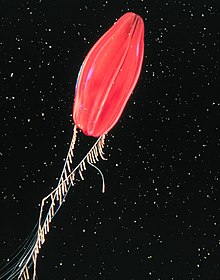
The classification of the Ctenophora has recently changed, and it now looks like comb jellies are unrelated to any other animal that has nerve cells. If this is true, it's possible that the nerve cells in comb jellies evolved completely independently. This would mean that nervous systems are not unique and the likelihood of alien organisms with at least complex behaviour is greatly increased.
Subscribe to:
Posts (Atom)